After several articles on Neutron, we have finally arrived at the next core OpenStack project. This time, we will introduce Glance, which is often overlooked but very important.
Contents
What is Glance?
在Official Documentation DefinitionIt states the following:
The Image service (Glance) allows users to upload and discover data assets intended for use with other services. It currently provides images and metadata definitions.
Simply put, Glance is a service that allows you to store and download images and metadata definitions.
Images
The Glance image service includes searching, uploading, and downloading virtual machine (VM) images. Glance features a RESTful API that allows users to query VM image metadata and download the actual image data.
There are many ways to store images; currently, the most common ones include the local filesystem, Ceph, Swift, and others.
Metadata Definitions
While storing images, Glance can also store a Metadata Definitions Catalog. This provides other OpenStack services with a way to determine various metadata key names and values applicable to OpenStack resources via API calls.
Note that Glance is only responsible for storing these key-value pairs; unless you apply them to other OpenStack services, this data will not take effect.
Architecture
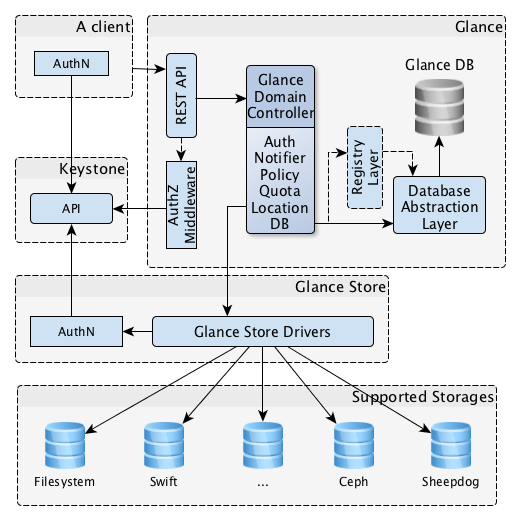
The architecture of Glance is very simple, consisting basically of only one component: glance-api. It is responsible for providing the API to users and connecting to various storage backends.
Summary
Although Glance is a relatively simple component within OpenStack, the image storage service it provides is an indispensable part of the ecosystem. In the next article, I will introduce Cinder, after which we will begin the process of actually deploying OpenStack onto physical machines.
Copyright Notice: All articles on this blog are licensed under CC BY-NC-SA 4.0 unless otherwise specified.

