In the previous article, we introduced DevStack and MicroStack, two deployment methods that are very easy to get started with but are primarily geared towards development and testing. Today, I will introduce TripleO and OpenStack Charms, two deployment tools backed by powerful vendors.
Contents
TripleO
TripleO is an abbreviation for "OpenStack on OpenStack." It is an OpenStack project whose primary function is to use OpenStack components to help you deploy and maintain an OpenStack cloud suitable for production environments.
Currently, TripleO is primarily maintained by Red Hat and serves as the upstream deployment project for Red Hat OpenStack Platform (RHOSP).
Architecture Overview
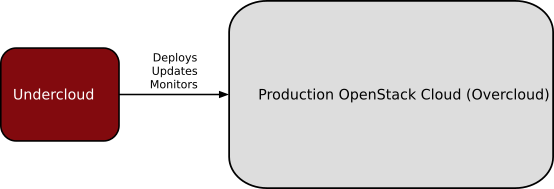
As mentioned earlier, TripleO stands for "OpenStack on OpenStack," meaning you will have two OpenStack environments. One environment is called the "undercloud." The undercloud contains the necessary OpenStack components to deploy our "overcloud." The overcloud is the OpenStack cluster deployed by the undercloud, which can be used for production, staging, testing environments, and more.
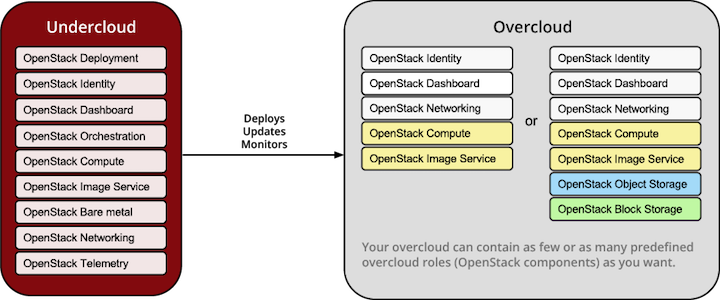
TripleO leverages several existing core OpenStack components—including Nova, Ironic, Neutron, Heat, Glance, and Ceilometer—to deploy OpenStack on bare metal. Within the undercloud, Nova and Ironic are used to manage the bare metal instances of the overcloud infrastructure. Neutron provides the networking environment for deploying the overcloud, images are stored in Glance, and Ceilometer collects monitoring data for your overcloud.
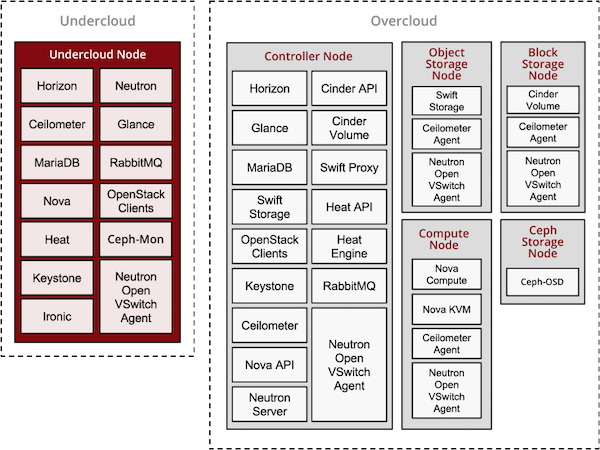
The diagram below illustrates how to deploy the undercloud on a single bare metal server and how to distribute the overcloud across multiple bare metal servers.
OpenStack Charms
Just as TripleO is the OpenStack deployment tool primarily maintained by Red Hat, OpenStack Charms is the deployment tool primarily maintained by Canonical (the company behind the Ubuntu distribution).
Simply put, Charmed OpenStack is a production-ready OpenStack distribution that utilizes MAAS, Juju, and OpenStack Charms to simplify the deployment and management of OpenStack clouds.
OpenStack Charms deploys the entire environment through various Charms within Juju, so it can currently only be installed on Ubuntu. Since I have limited experience with Juju, I won't go into much detail here. Those who want to learn more about how to deploy OpenStack Charms or wish to test it out can refer to...Official Documentation
Summary
The two OpenStack deployment methods mentioned above are maintained by the major open-source companies Red Hat and Canonical, respectively, and serve as the upstream versions for their paid distributions. We will introduce the remaining deployment tools in the next article. The tools covered in the next post are more community-maintained, but they have a large user base and are widely recognized by the community for use in production environments.
Copyright Notice: All articles on this blog are licensed under CC BY-NC-SA 4.0 unless otherwise specified.

